The Importance of Accurate Demand Forecasting
As we navigate the complexities of 2026, the global supply chain landscape has fundamentally shifted. Gone are the days when operations leaders could rely on cyclical, year-over-year historical data to predict future consumer behavior.
Geopolitical realignments, rapid climate events, and viral social media trends mean that consumer demand is more volatile, fragmented, and unpredictable than ever before. The solution lies in the convergence of next-generation demand forecasting software, real-time demand sensing, and dynamic automated replenishment.
The companies that can sense minute changes in the market instantly and execute physical inventory moves flawlessly will be the ones that thrive.
The Evolution of Demand Forecasting Software
Historically, supply chain forecasting was an exercise in looking backward through a rearview mirror. Planners would extract historical sales data, apply a seasonal curve, manually adjust for promotions, and hope the market behaved as expected.
While this time-series approach worked in stable environments, today's omni-channel retail reality exposes its fatal flaw: crippling latency. By the time traditional planning systems recognize a structural shift in demand, retail shelves are already empty — or distribution centers are overflowing with obsolete stock.
Modern demand forecasting software has evolved from a static calculator into a dynamic, AI-driven predictive engine. According to recent 2025/2026 industry analyses, organizations utilizing AI-augmented forecasting platforms have seen forecast accuracy improve by as much as 35% compared to those relying on legacy methodologies.
The 2026 Context: SKU Proliferation and Network Complexity
Two massive trends are forcing the hand of supply chain leaders in 2026:
- Hyper-personalization: Consumers now expect products tailored to their local tastes, leading to unprecedented SKU proliferation across all major verticals
- Supply network restructuring: Geopolitical pressures have accelerated nearshoring and friendshoring initiatives, making networks far more multi-echelon
Managing thousands of active SKUs across a decentralized network of regional distribution centers, micro-fulfillment nodes, and localized suppliers makes manual forecasting entirely impossible. Advanced demand forecasting software is no longer a luxury — it is the fundamental operating system required to manage this complexity.
Demystifying Demand Sensing
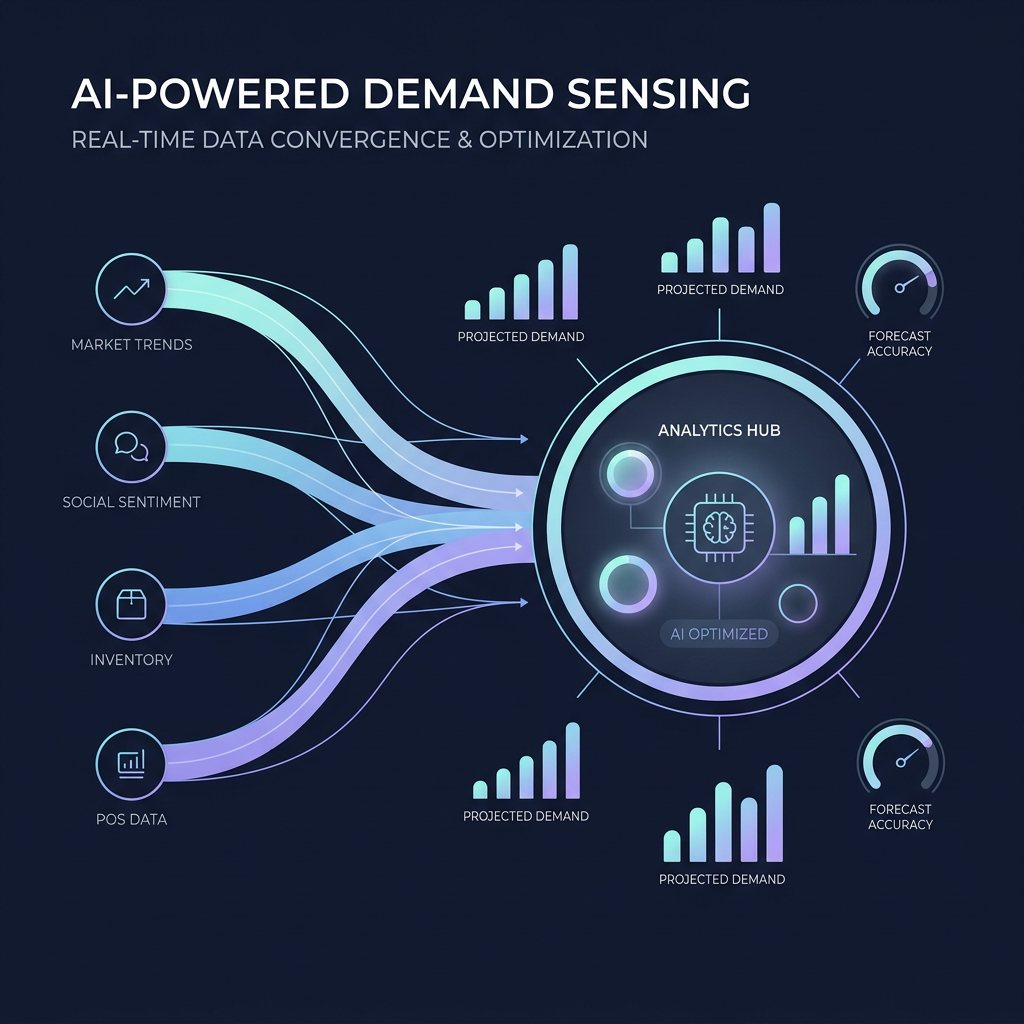
The technological catalyst for this forecasting shift is demand sensing. While traditional forecasting looks at historical shipment data to predict long-term trends, demand sensing focuses on the extreme short-term by capturing and analyzing real-time signals at the very edge of the supply chain.
These diverse data signals include:
- Point-of-Sale (POS) data: Consumption data and daily retail sell-through rates
- Weather patterns: Real-time localized climate forecasts
- Social media sentiment: Viral trends and influencer impacts
- Macroeconomic indicators: Localized demographic shifts
- Competitor intelligence: Pricing changes and sudden promotional shifts
Why Demand Sensing is a Game Changer
Demand sensing dramatically reduces the time it takes to detect a demand signal and propagate that insight upstream through the supply chain network.
For example, if an unexpected weather event drives a sudden spike in a specific SKU category, demand sensing algorithms pick up on this anomaly at the retail level immediately. Instead of waiting for the end-of-week planning cycle, the system adjusts the short-term forecast instantly.
This capability allows planners to pivot from reactive firefighting to proactive, strategic management — vastly reducing the dreaded bullwhip effect that has historically plagued complex supply networks.
The Engine of Efficiency: Automated Replenishment
A hyper-accurate, real-time forecast is only valuable if it translates into swift physical execution. This is where demand sensing feeds directly into the operational muscle of automated replenishment.
In the past, replenishment was a manual, rule-based process governed by rigid Min/Max thresholds. Planners spent countless hours reviewing reorder reports and manually tweaking safety stock levels. Modern automated replenishment systems leverage the real-time feed from demand sensing to dynamically adjust inventory parameters across the entire network.
The Tangible ROI of Automation
When powered by AI, automated replenishment optimizes the entire inventory profile holistically:
- Optimal reorder timing: Calculates the best time to place each order
- Precise quantities: Determines exact amounts factoring in lead times and volume discounts
- Network-aware fulfillment: Selects the best node considering transportation costs and warehouse capacity
Organizations making this digital shift routinely report:
- 15-20% reduction in safety stock levels
- Up to 10% improvement in on-time-in-full (OTIF) delivery rates
- Dramatic reduction in expensive last-minute air freight expedites
Instead of spending 80% of their time on data entry and standard orders, buyers can focus on strategic supplier relationships and complex new product introductions.
Actionable Strategies for Operations Leaders
Transitioning to this AI-driven planning paradigm doesn't happen overnight. Here are four actionable steps:
-
Audit Your Data Latency: Assess how long it takes for a raw demand signal to influence your upstream supply plan. If it's measured in weeks rather than hours, you have a critical gap to close.
-
Embrace Exception-Based Management: Train your teams to trust algorithmic outputs. Let planners focus their expertise on high-value, high-volatility items while automation handles stable SKUs.
-
Break Down Organizational Silos: Ensure commercial, marketing, and supply chain teams operate from a single source of truth. Demand sensing works best when promotional plans and market intelligence feed into the same engine.
-
Invest in Cloud-Native Architecture: Legacy on-premise ERP systems often lack the horsepower to process millions of real-time variables. Cloud-native solutions can ingest diverse datasets without grinding operations to a halt.
The Future of Intelligent Planning
As supply chains continue to face unprecedented complexities in 2026 and beyond, the margin for error will only continue to shrink. The convergence of demand sensing, AI-powered forecasting, and automated replenishment represents the new standard for competitive supply chain operations.
Platforms like ForecastWorx are built specifically for this reality — combining real-time demand signals with intelligent automation to help planning teams make better decisions, faster. The question isn't whether to modernize your forecasting approach — it's how quickly you can make the transition.